Pearson Edexcel · GCSE · Psychology
Course version: 1PS0 · Version from Sept 2017
Young (2007) Cognitive Behavior Therapy with Internet Addicts: Treatment…
Full specification wording
Studies: 3.2.2 Young (2007) Cognitive Behavior Therapy with Internet Addicts: Treatment Outcomes and Implications
Young (2007) investigated the effectiveness of Cognitive Behavioural Therapy (CBT) for internet addiction.
Checked against the Pearson Edexcel 1PS0 specification (opens in a new tab) on .
- Point 2 of 2
- 4 key terms
Study notes
From the checked teaching notes for this specification point.
The idea
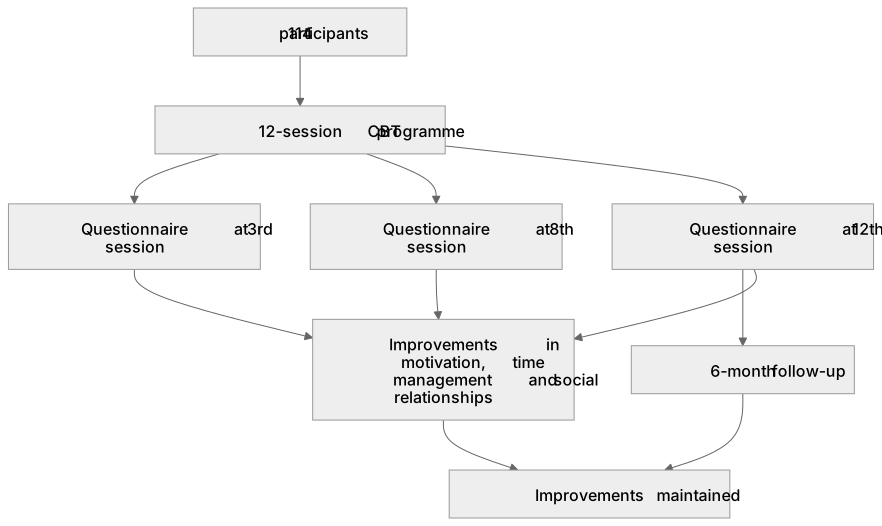
Young (2007) investigated the effectiveness of Cognitive Behavioural Therapy (CBT) for internet addiction. The study involved 114 participants who completed a 12-session CBT programme. Treatment outcomes were measured using a questionnaire at the 3rd, 8th, and 12th sessions, and a 6-month follow-up. Results showed significant improvements in motivation, time management, and social relationships, which were maintained at the 6-month follow-up. This implies that CBT is an effective treatment for internet addiction, offering long-term benefits.
What earns the marks
- Identify the aim of the study: to investigate the effectiveness of CBT for treating internet addiction.
- Recall the sample characteristics and procedure, including the 114 participants and the 12-session treatment programme.
- Describe the findings, noting the continuous improvement across sessions that was maintained at the 6-month follow-up.
- Evaluate the study by identifying methodological strengths, such as the use of a follow-up, and weaknesses, such as self-report bias and the absence of a control group.
Common mistakes and how to put them right
Believing the study used a control group to compare treatments.
Put it right: The study did not use a control group; all participants received the CBT treatment.
Confusing the follow-up period.
Put it right: The follow-up was conducted at 6 months, not 12 months or 1 year.
Assuming the data collected was entirely objective.
Put it right: The data was collected via self-report questionnaires, which are subjective and prone to social desirability bias.
Exam tips
- Memorise the specific time intervals when data was collected (3rd, 8th, 12th sessions, and 6-month follow-up) to answer specific multiple-choice questions accurately.
- Use the lack of a control group as a key evaluation point when discussing the validity of the findings.
- Link the findings directly to the implications: CBT is a viable, long-term treatment for internet addiction.
Try the lesson
The start of the Studies: 3.2.2 Young (2007) Cognitive Behavior Therapy with Internet Addicts: Treatment Outcomes and Implications lesson, made from checked teaching notes for this specification point.
Have a go first
What was the primary aim of the study conducted by Young (2007)?
Listen
Young (2007) investigated the effectiveness of Cognitive Behavioural Therapy (CBT) for internet addiction. The study involved 114 participants who completed a 12-session CBT programme. Treatment outcomes were measured using a questionnaire at the 3rd, 8th, and 12th sessions, and a 6-month follow-up. Results showed significant improvements in motivation, time management, and social relationships, which were maintained at the 6-month follow-up. This implies that CBT is an effective treatment for internet addiction, offering long-term benefits. A strong answer earns marks for these points. Identify the aim of the study: to investigate the effectiveness of CBT for treating internet addiction. Recall the sample characteristics and procedure, including the 114 participants and the 12-session treatment programme. Describe the findings, noting the continuous improvement across sessions that was maintained at the 6-month follow-up. Evaluate the study by identifying methodological strengths, such as the use of a follow-up, and weaknesses, such as self-report bias and the absence of a control group. A common slip: Believing the study used a control group to compare treatments. Instead, The study did not use a control group; all participants received the CBT treatment. Exam tip: Memorise the specific time intervals when data was collected (3rd, 8th, 12th sessions, and 6-month follow-up) to answer specific multiple-choice questions accurately.
See it
Key words
Say what each word means before you turn the card.
Cognitive Behavioural Therapy
Try answering aloud or in your head before turning the card.
Addiction
Try answering aloud or in your head before turning the card.
Treatment of psychological problems
Try answering aloud or in your head before turning the card.
Research methods and evaluation
Try answering aloud or in your head before turning the card.
See every definition
- Cognitive Behavioural Therapy
- A therapy whose effectiveness for internet addiction was investigated in a 12-session programme completed by 114 participants.
- Addiction
- Internet addiction was the condition treated in the study, with CBT found to be an effective treatment offering long-term benefits.
- Treatment of psychological problems
- The study implies CBT is an effective treatment for internet addiction, with improvements maintained at the 6-month follow-up.
- Research methods and evaluation
- Students must evaluate the study's methodology, such as its reliance on self-report data and the lack of a control group.
Label the diagram
Some boxes have lost their names. Pick the right name for each number.
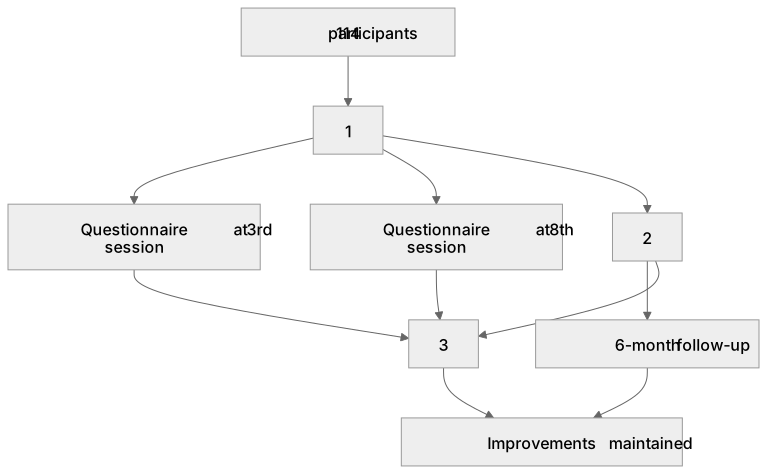
1Box 1
2Box 2
3Box 3
There is more to this lesson
The full lesson goes on to check your understanding and help you earn the marks. Create a free account to carry on, with your progress saved.
A week of Premium from your first lesson · Then the free plan continues · No card, no charge
Test your understanding of Studies: 3.2.2 Young (2007) Cognitive Behavior Therapy with Internet Addicts: Treatment Outcomes and Implications
Active recall beats re-reading. Take an instant quiz now to test what you’ve learned and lock it into long-term memory.
A week of Premium from your first lesson · Then the free plan continues · No card, no charge